
1 Guide to the book
A Brief Guide toNumber Theory
Explore the beauty of Olympiad Number Theory
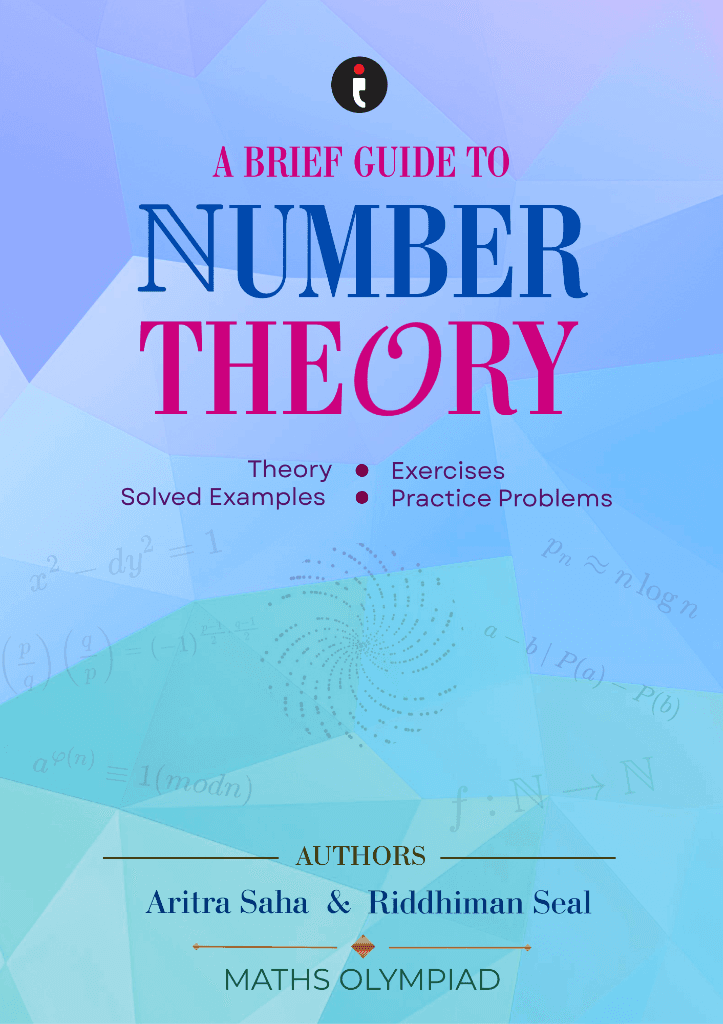
About the Book.
A Brief Guide to Number Theory is a book that focuses on elementary number theory, specifically topics that are common in Olympiad mathematics. We start from the basics of modular arithmetic and progress to advanced concepts like quadratic reciprocity, Pell's equations, and density in number theory.
Number-theoretic functional equations are on the rise, with at least one appearing in the IMO number theory shortlist in recent years. It is quite surprising that there are so few comprehensive resources on this topic. Hence, we have dedicated an entire chapter to functional equations. The first subsection helps readers gain familiarity with regular algebraic techniques, while the next introduces number-theoretic ideas.
Another topic we have included is combinatorial number theory. Many problems in recent IMO number theory shortlists involve ideas that are combinatorial in nature. These problems often pose challenges to even the top ten countries at the IMO. Furthermore, very few resources are curated specifically for such problems, which is why we have written a section dedicated to them. This section focuses heavily on exercises and solved examples, though we do assume some basic knowledge of combinatorics. Prerequisites (for this section and the rest of the book in general) are mentioned on a separate page.
Each chapter consists of four major parts: theory, exercises, solved examples, and practice problems. Between the theory, we have included Exercise Problems to help readers gain a better understanding of the material. After each subchapter or section, we have added Solved Examples on the topic, along with complete solutions. We have also included Practice Problems where solutions are not provided, giving readers the opportunity to apply what they have learned independently.
For a long time, a student without extensive theoretical knowledge—but with strong fundamentals, a bit of creativity, and adequate preparation—could clear the INMO. However, in recent years, more and more problems have required a substantial theoretical background, especially in 2026, which featured solutions involving Zsigmondy's theorem, Catalan's conjecture, LTE, and Dirichlet's theorem. Furthermore, to do well in the IMOTC and at the IMO, having the theoretical prerequisites is a must. Hence, we have included most of the major concepts along with problems from various contests to help readers gain a deeper understanding of these topics.
In addition to the theory, we have carefully curated the problems for both the Solved Examples and Practice Problems. Rather than relying on problems that appear in most books and handouts, we chose to highlight lesser-known problems from recent years. For the first few chapters, almost all the Solved Examples are relatively new — some from not-so-well-known contests, and others from AoPS posts. One of the Solved Examples for Chapter 2 was sourced from a random AoPS post with a very short statement, yet ended up taking us hours just to write the solution. Some of the problems we have included are even from contests that we participated in last year, and a large chunk are from 2026 contests. In general, we aimed to make the Solved Examples decently challenging. By contrast, the Practice Problems are mostly from better-known contests and are somewhat simpler than the Solved Examples. This approach has helped readers engage with solutions to harder problems and practice with slightly easier ones, enhancing both understanding and problem-solving skills.
Our primary goal is to help readers understand and appreciate the beauty of number theory. We want students to gain intuition and a feeling for the subject instead of memorizing formulas and applying them blindly. Learning number theory requires patience and time; the journey is much more rewarding if you try to enjoy the subject rather than focus solely on the end results. The problems are undeniably hard, and you are strongly encouraged to take your time with them.
Contents & Preview.
Modular Arithmetic
- 1.1Meaning of ‘Mod’
- 1.2Inverse Modulo and its uses
Divisibility
- 2.1Fundamentals of Divisibility
- 2.2Greatest Common Divisor
- 2.3Techniques in Diophantine Equations
- 2.4Divisors
Advanced Modular Arithmetic
- 3.1Orders
- 3.2Primitive Roots
- 3.3Quadratic Residues
Prime Exponents & Polynomials
- 4.1P-adic valuation
- 4.2Integer Polynomials
- 4.3Cyclotomic Polynomials and their uses
Number Theoretic Functional Equations
- 5.1Algebraic Techniques in Functional Equations
- 5.2Number Theoretic Ideas in FE's
Miscellaneous Ideas
- 6.1Size and Density in Number Theory
- 6.2Combinatorial Number Theory
- 6.3Some Cool/Useful Theorems
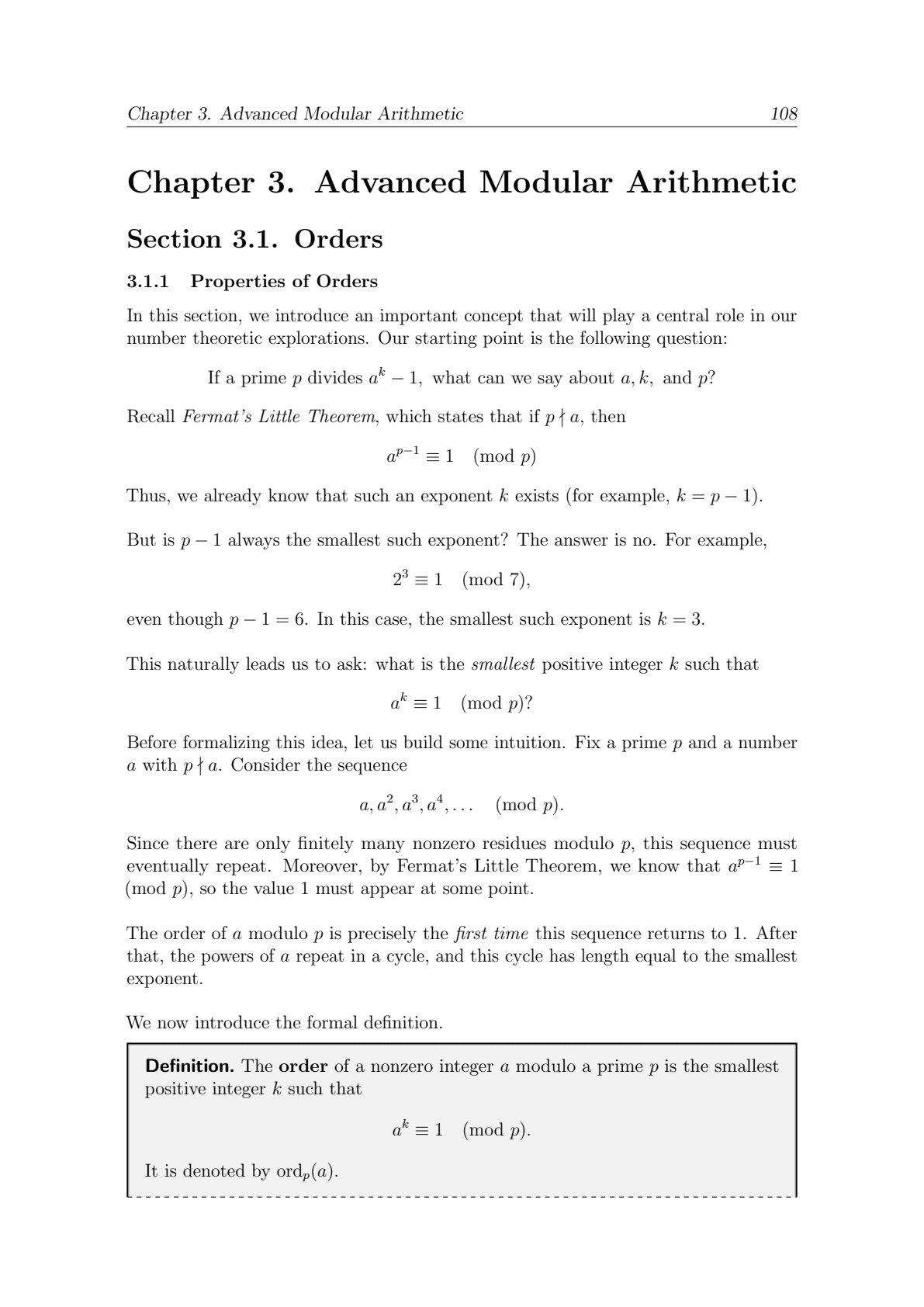
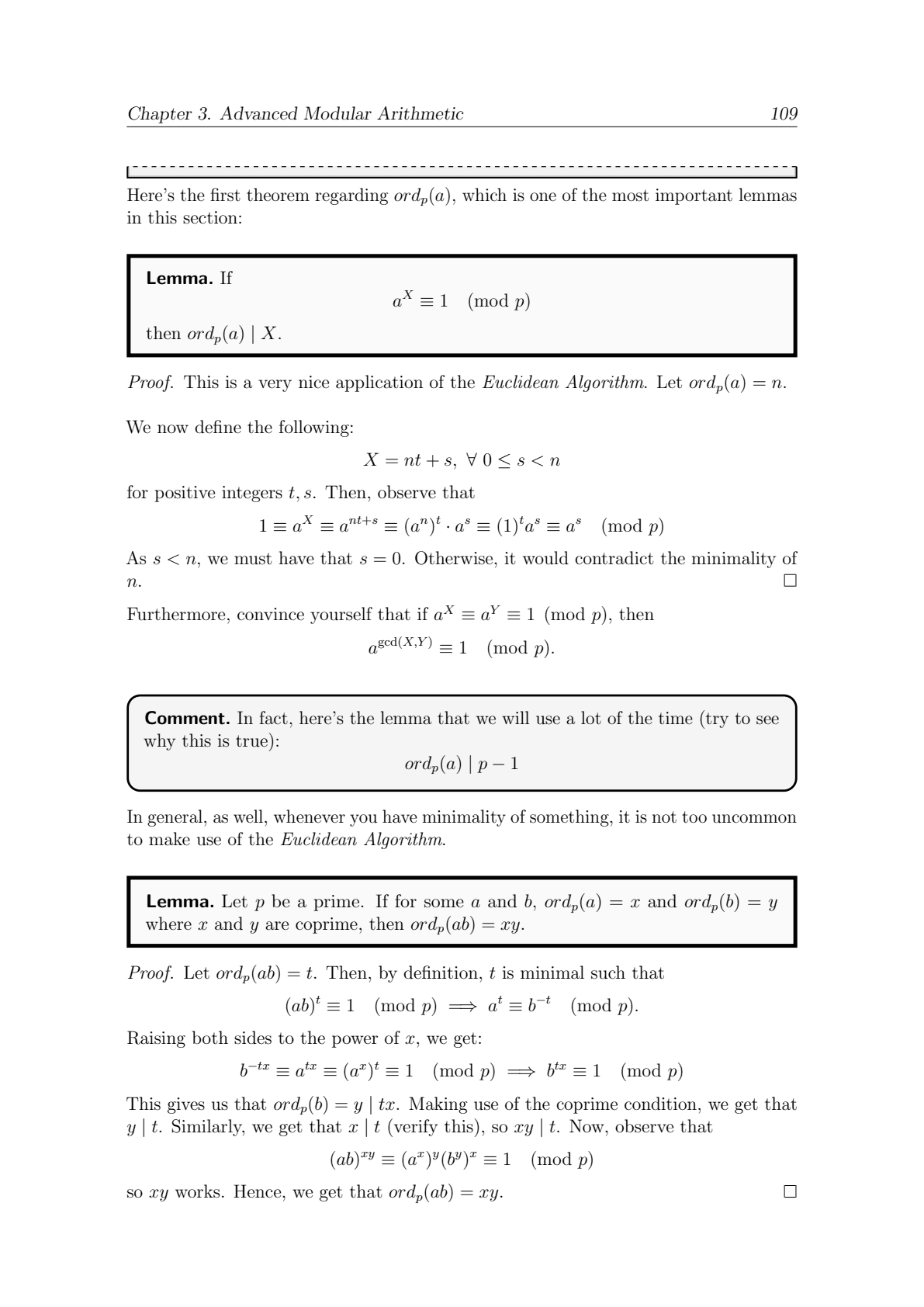
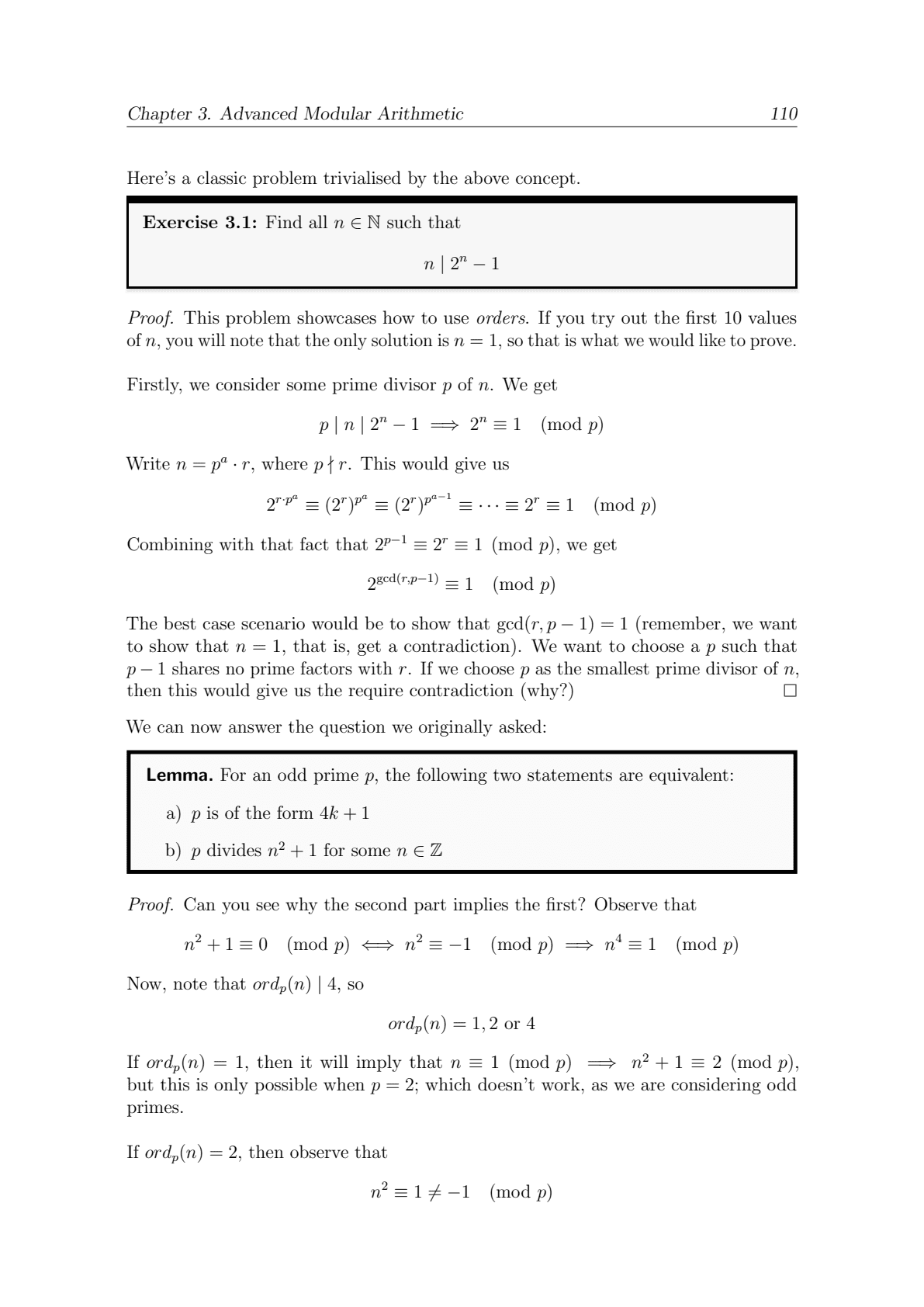
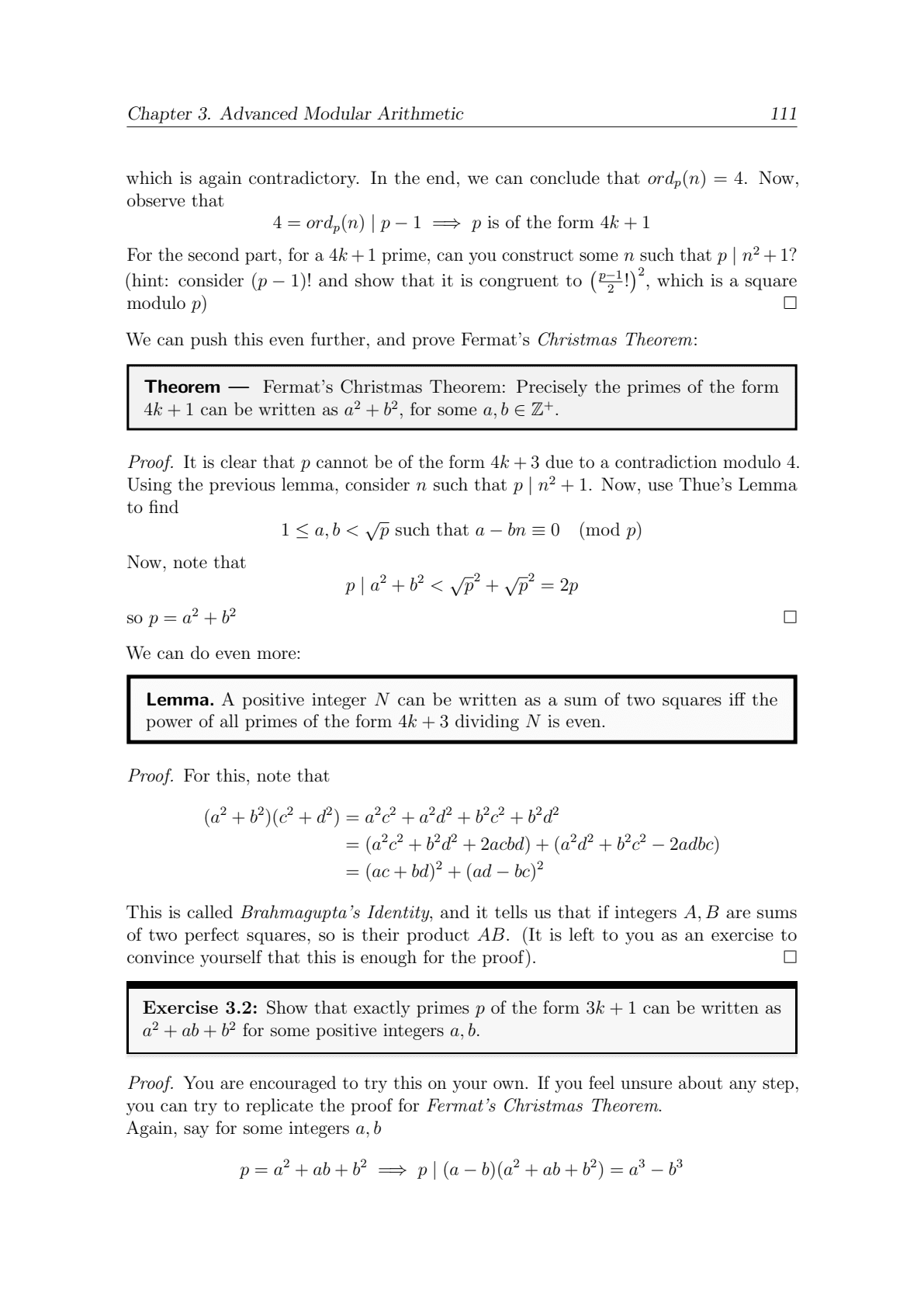
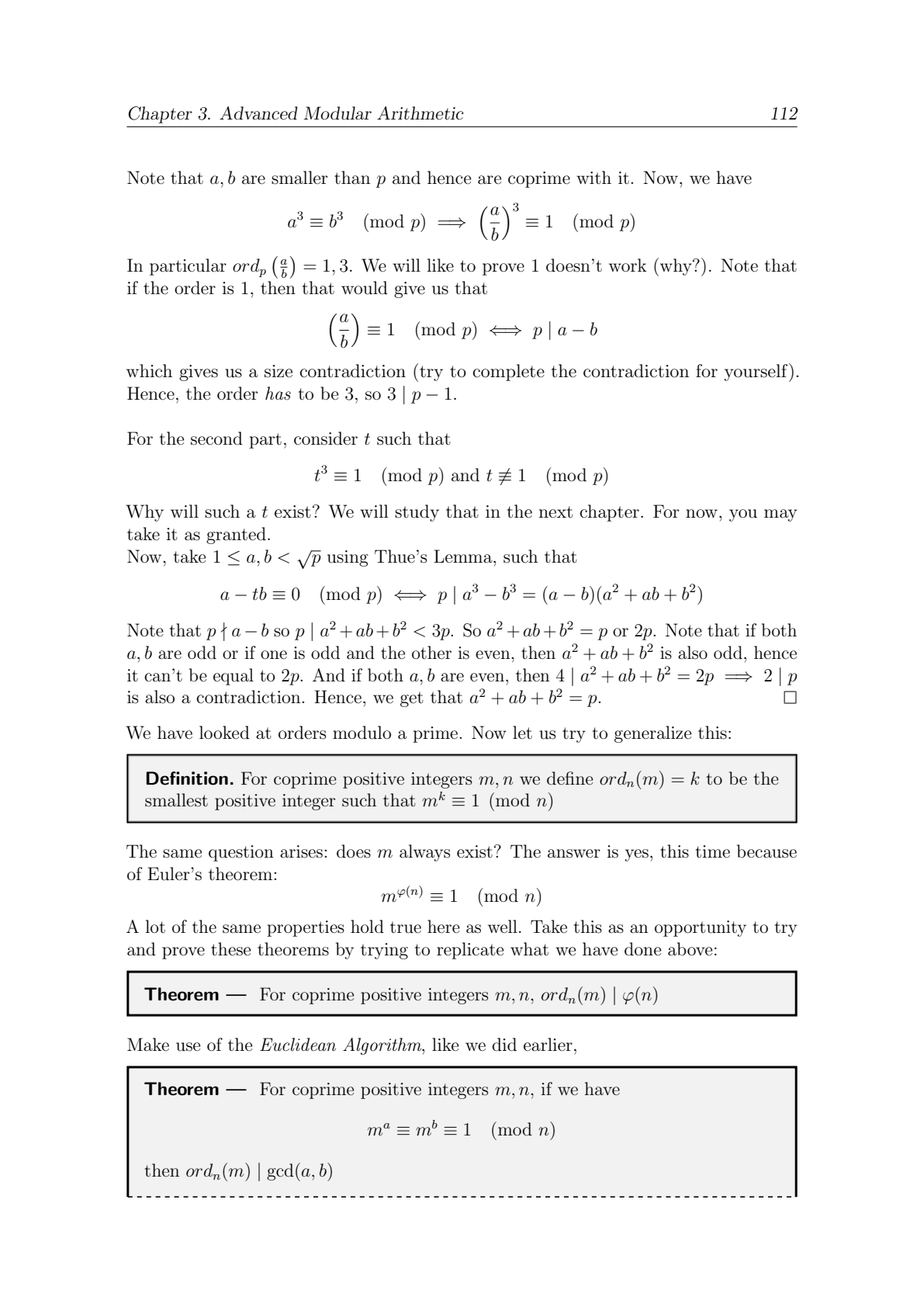
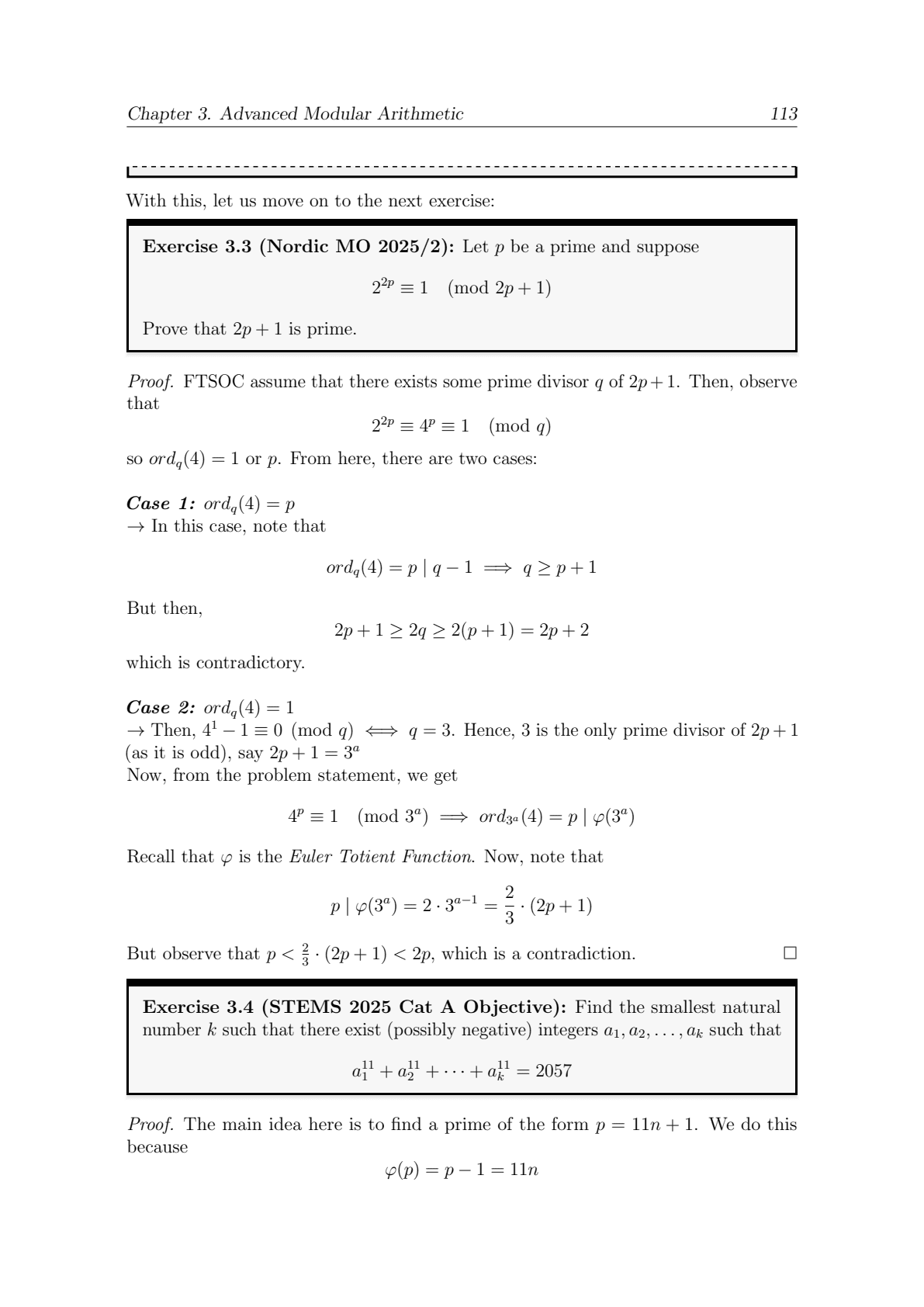
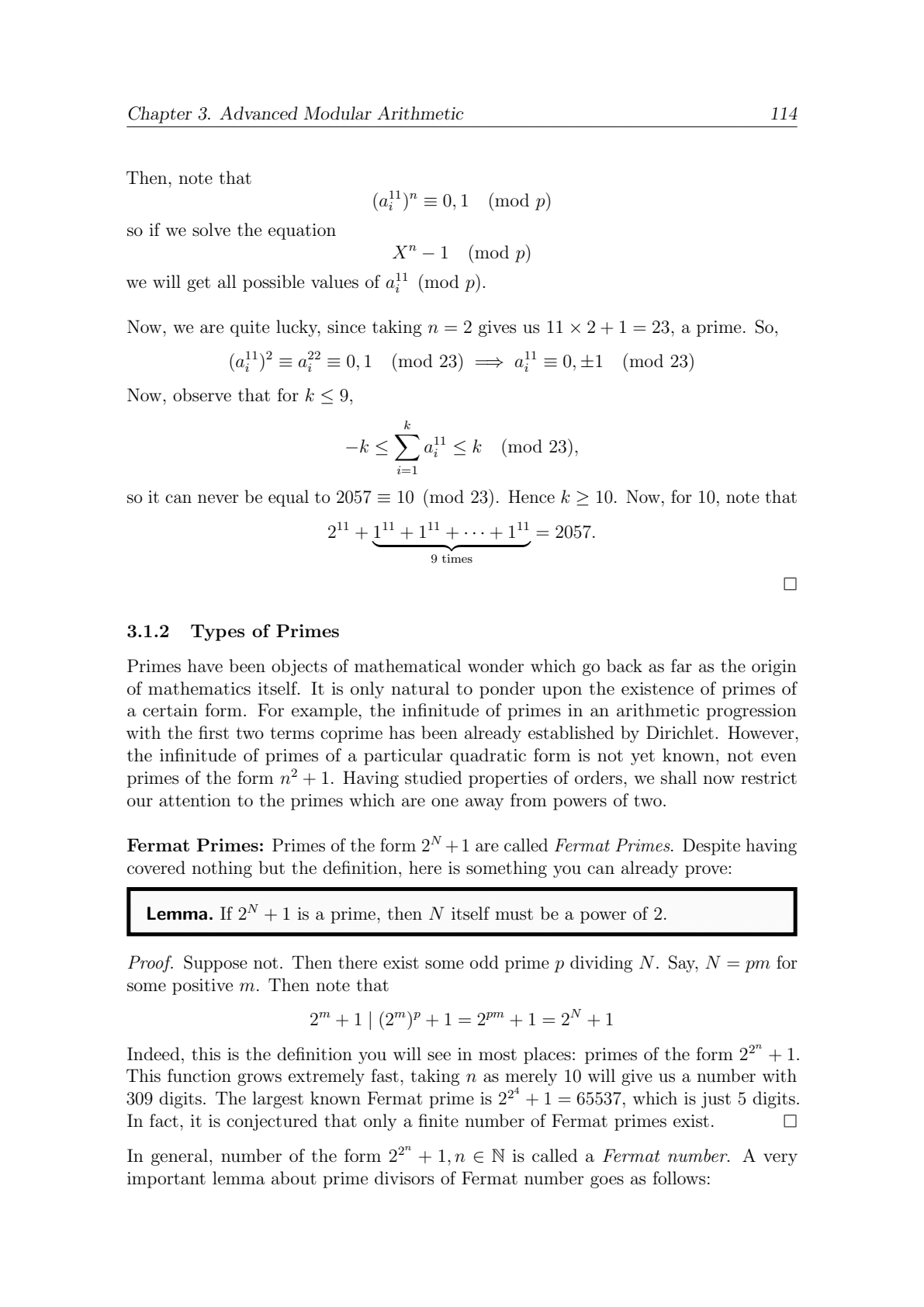
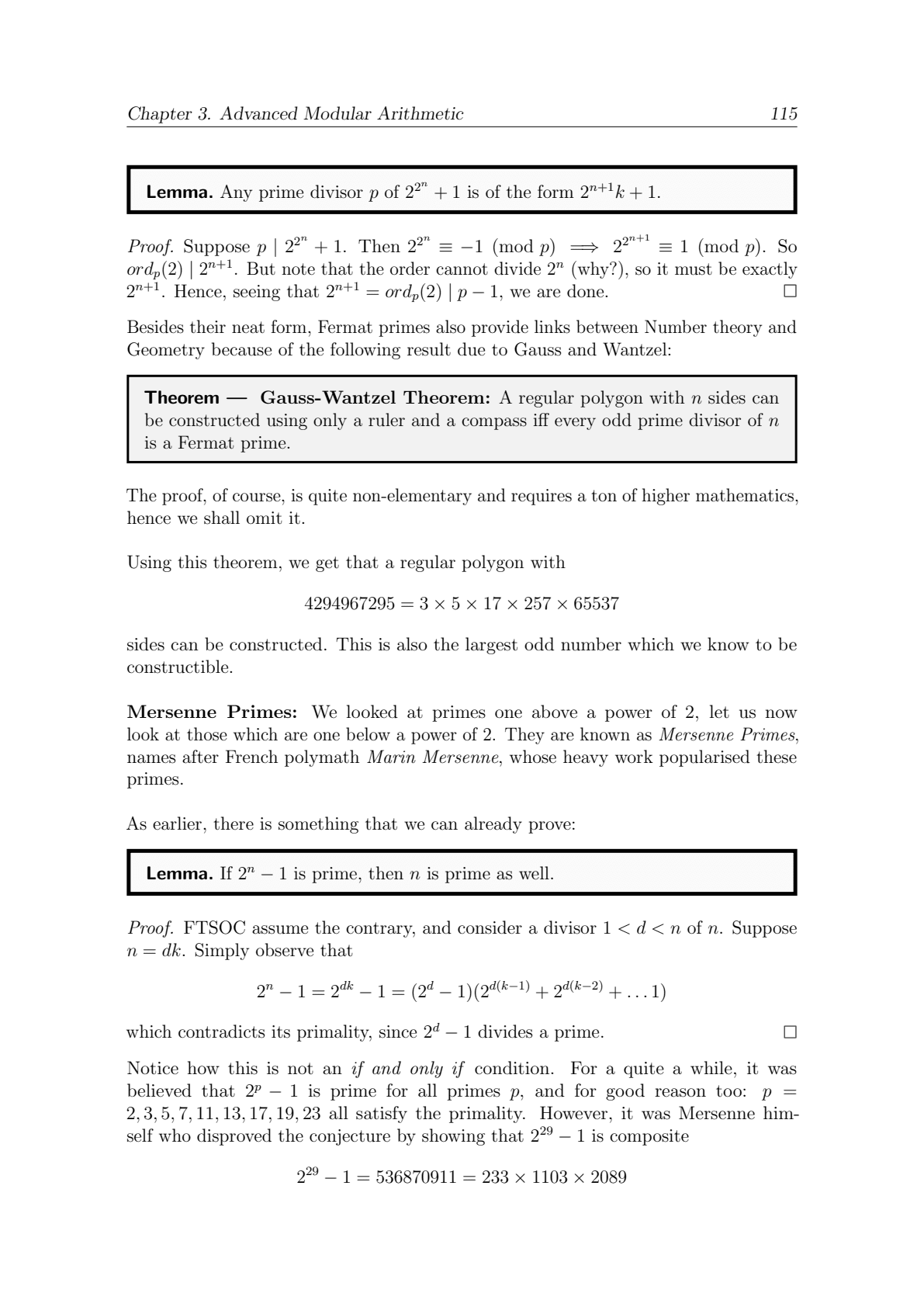
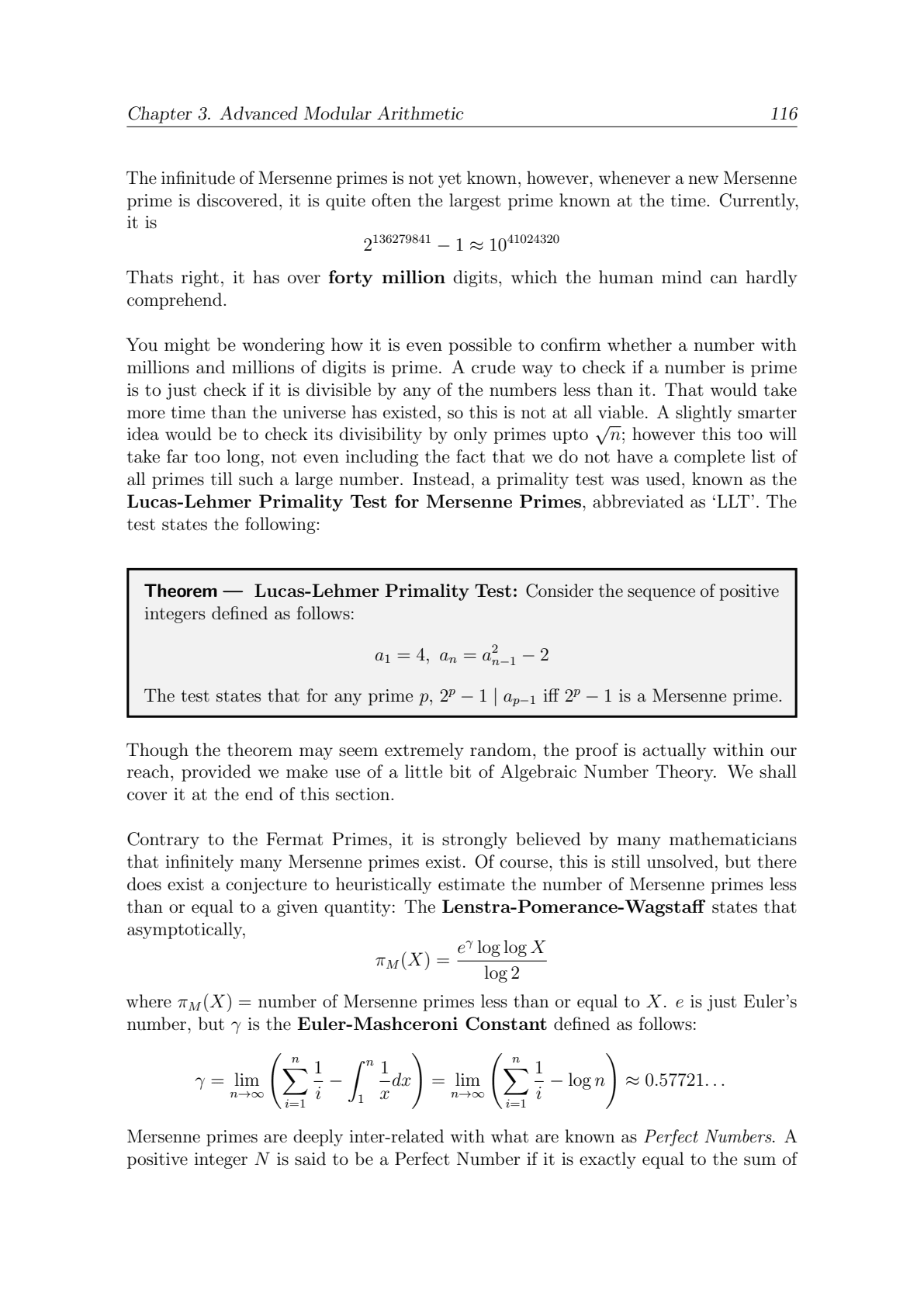
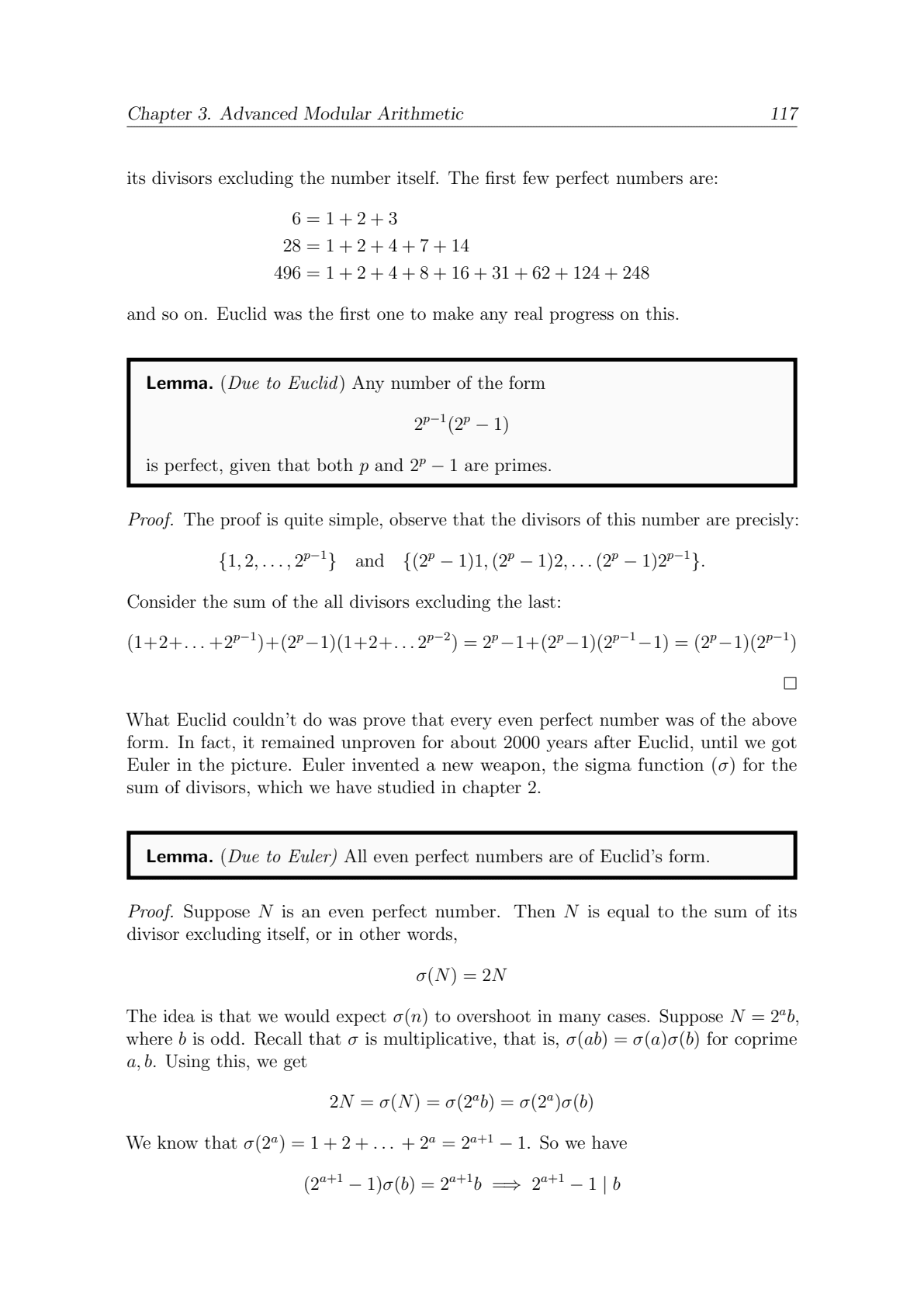
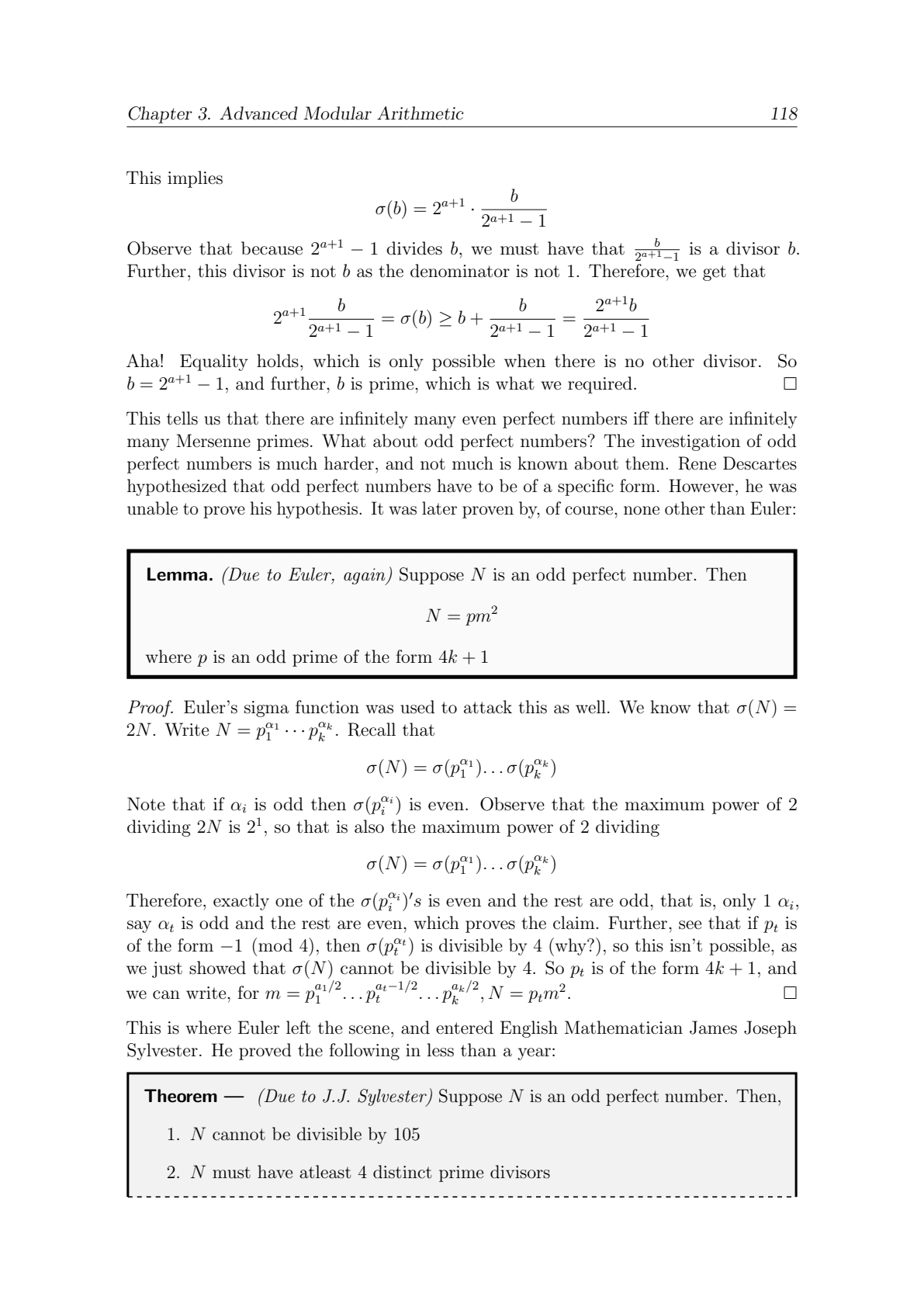
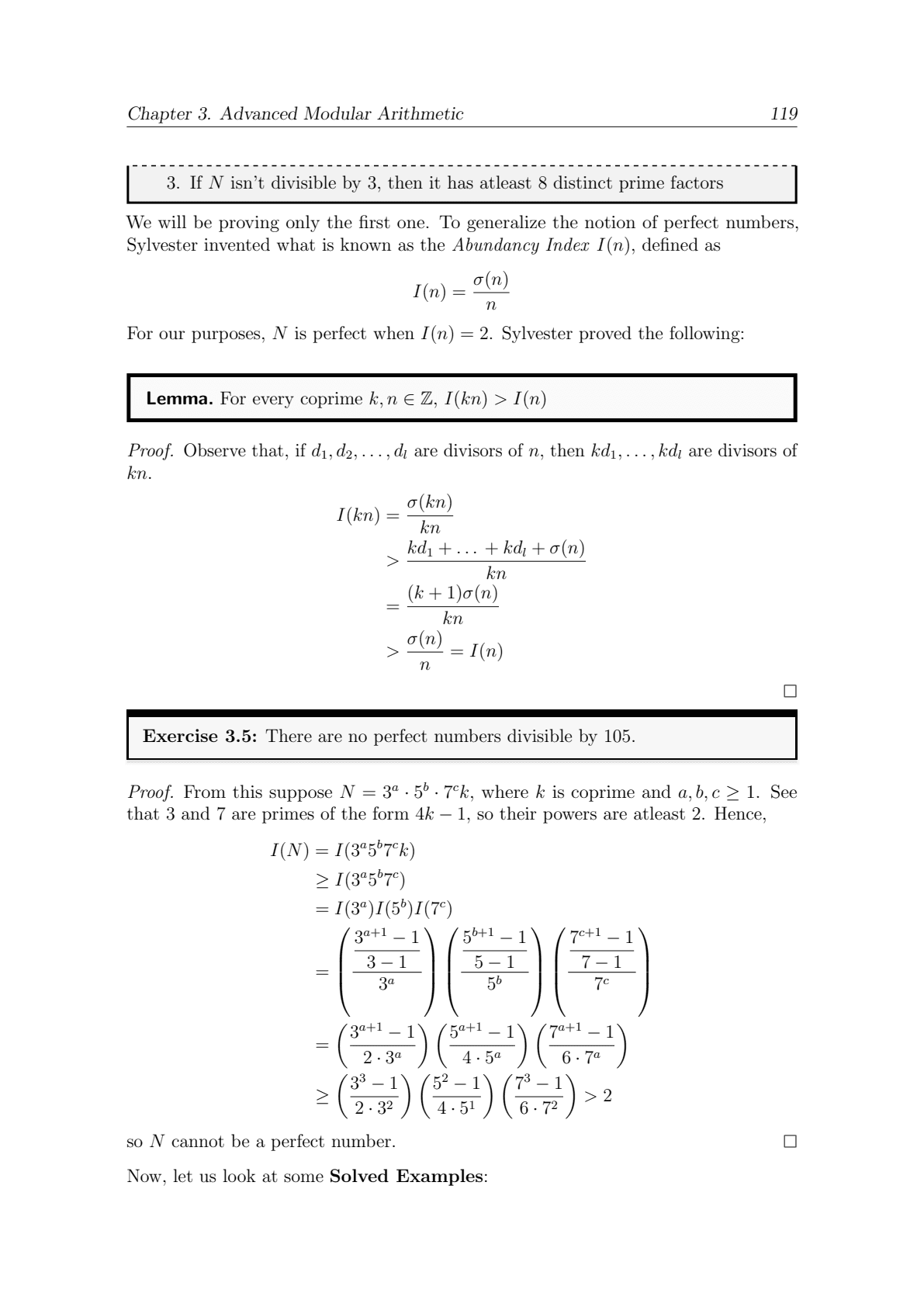
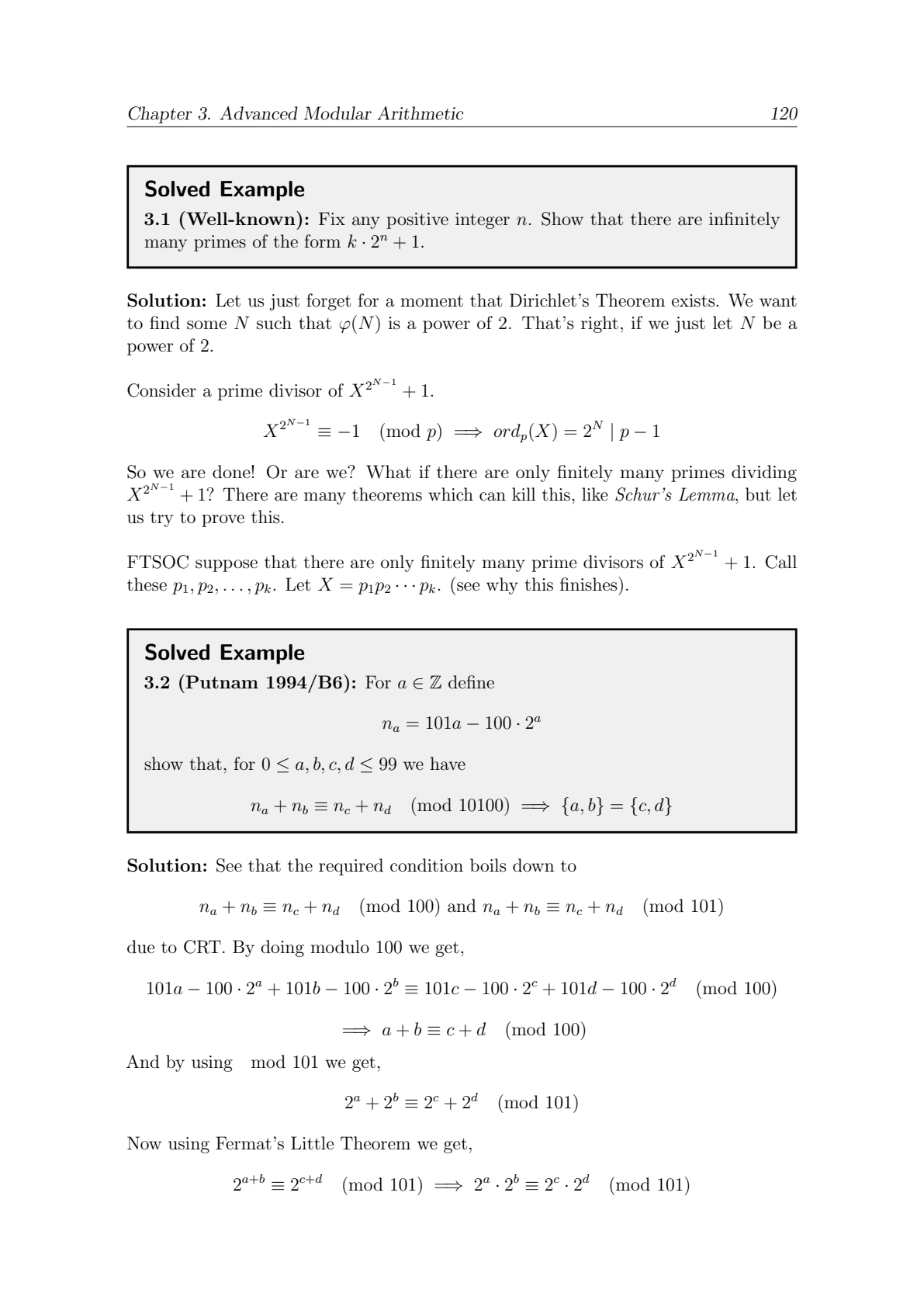
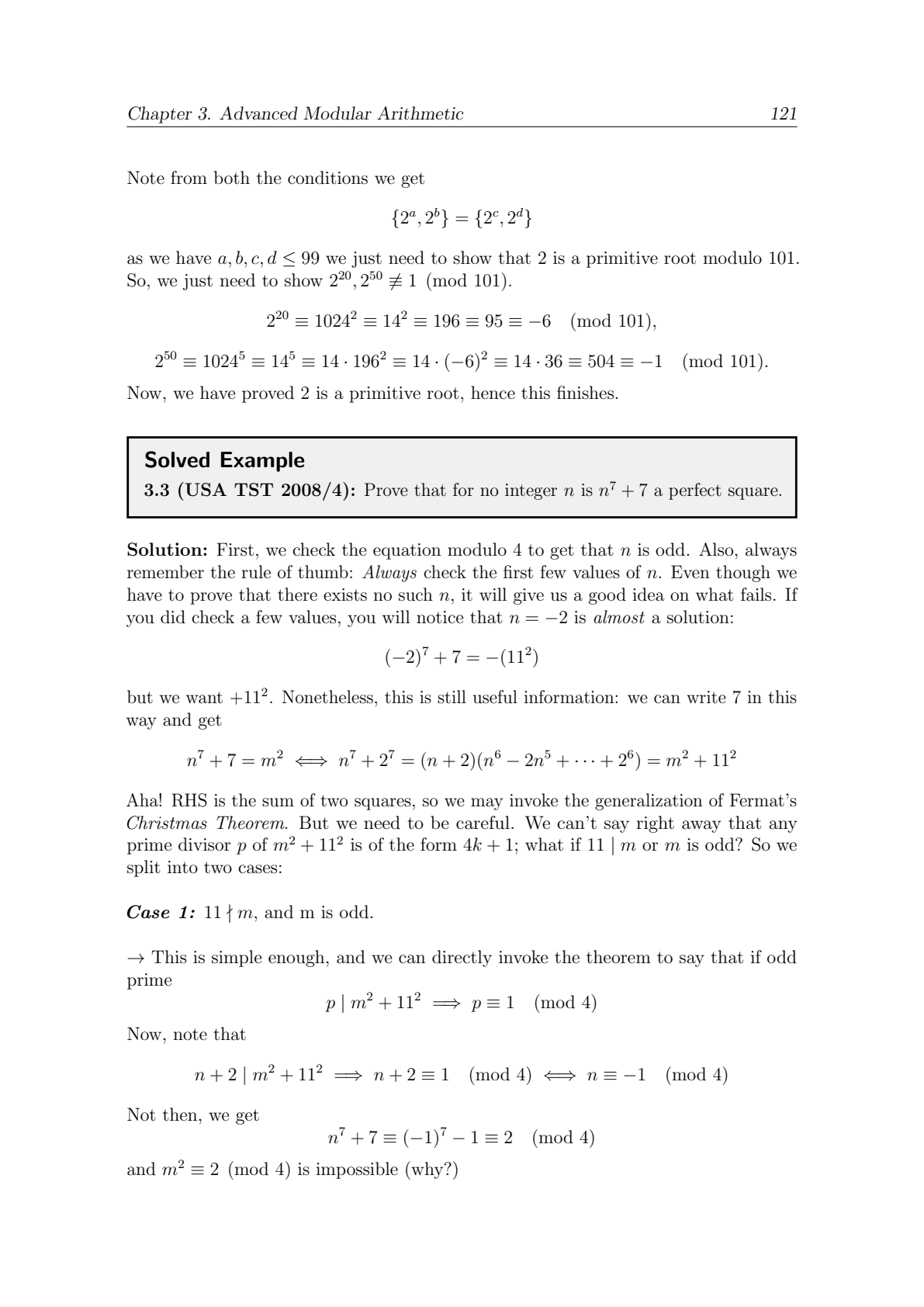
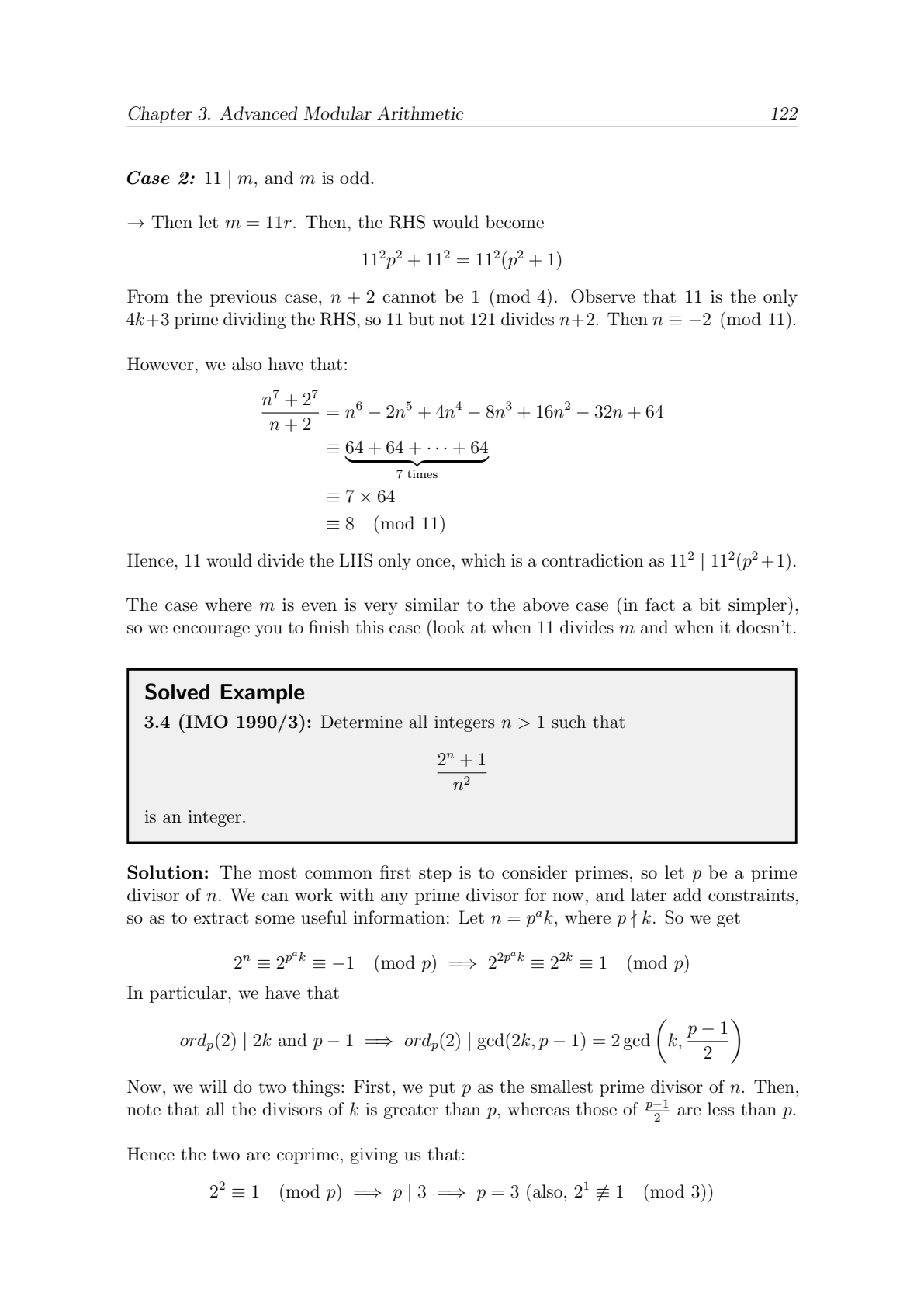
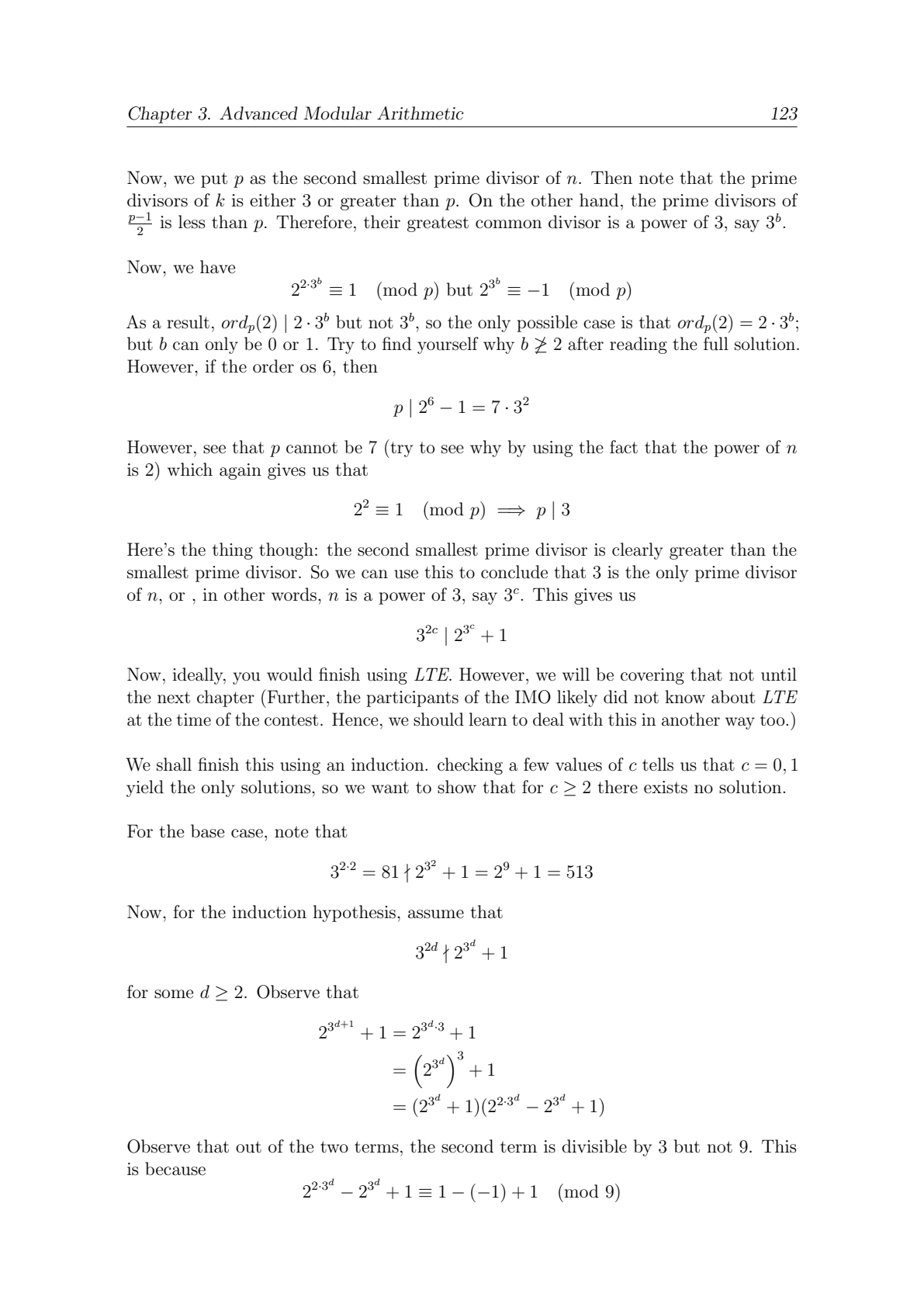
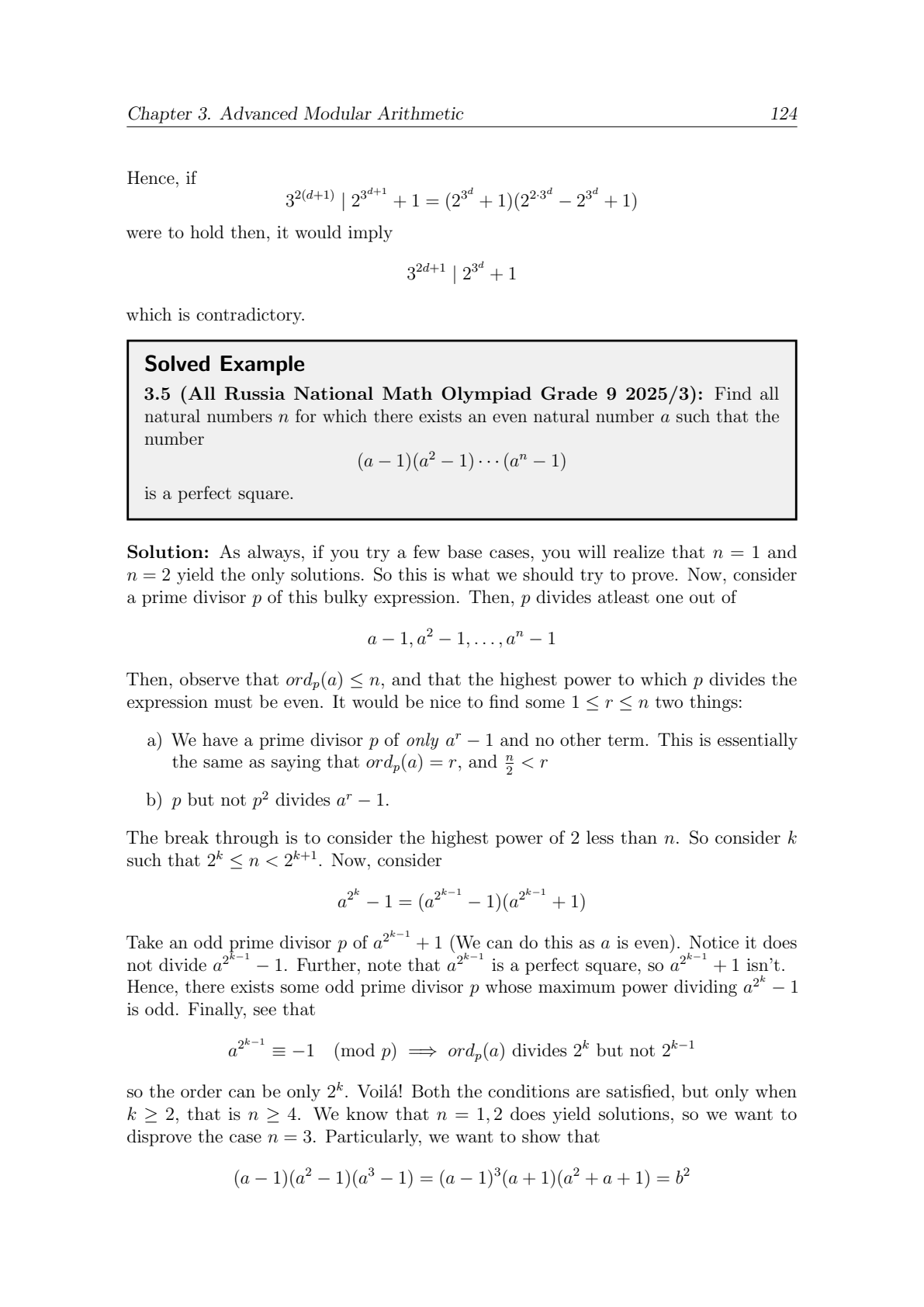
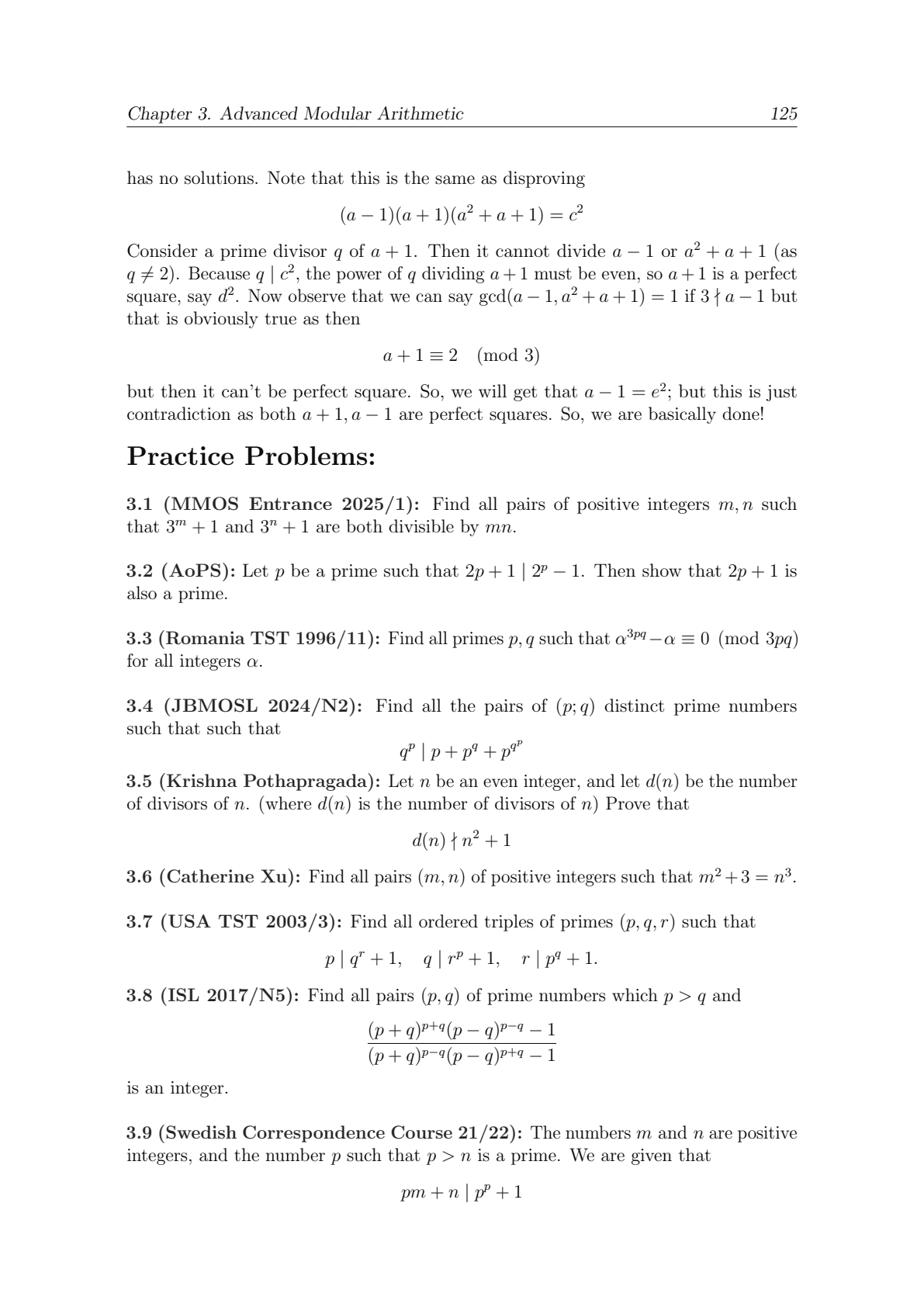
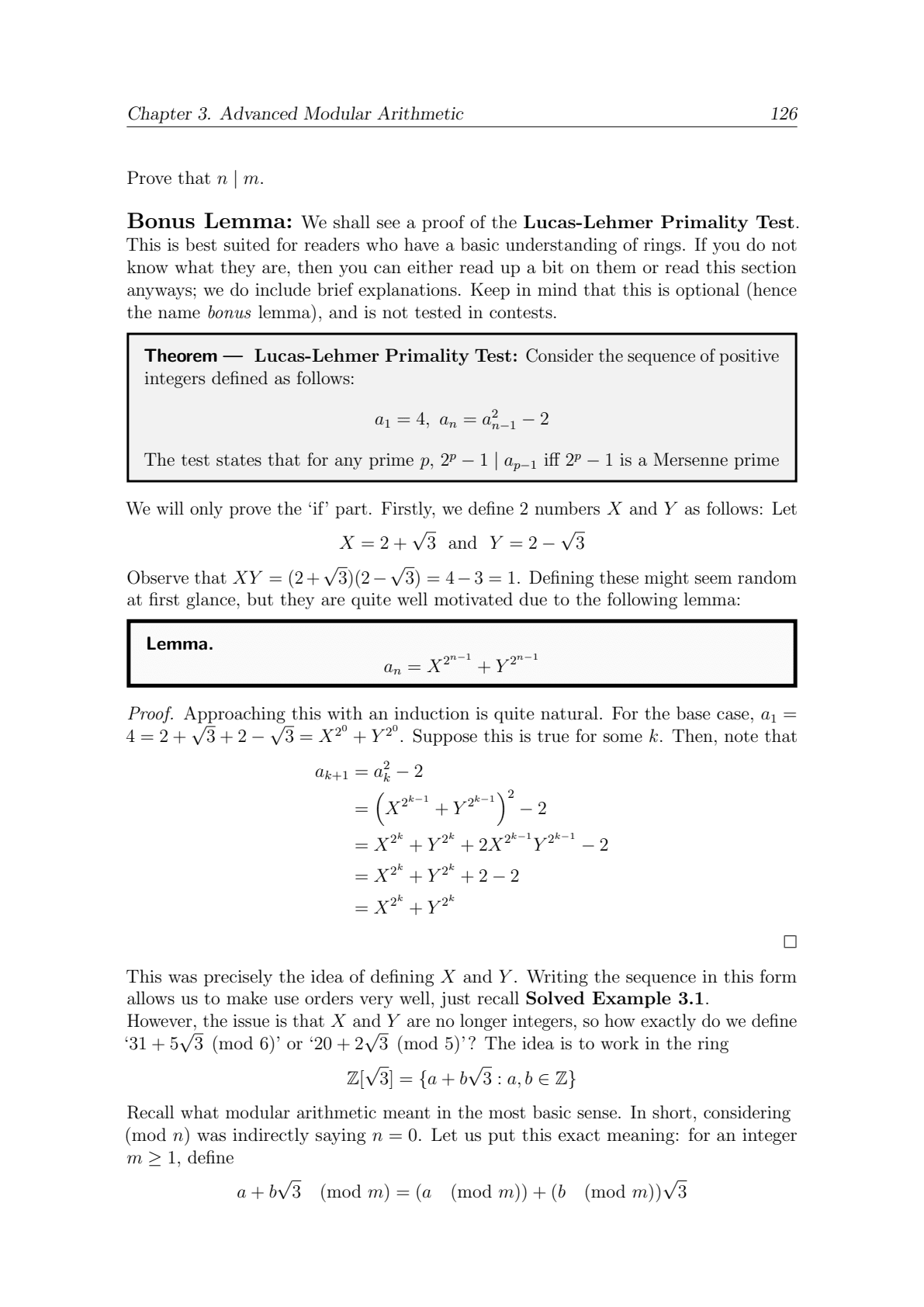
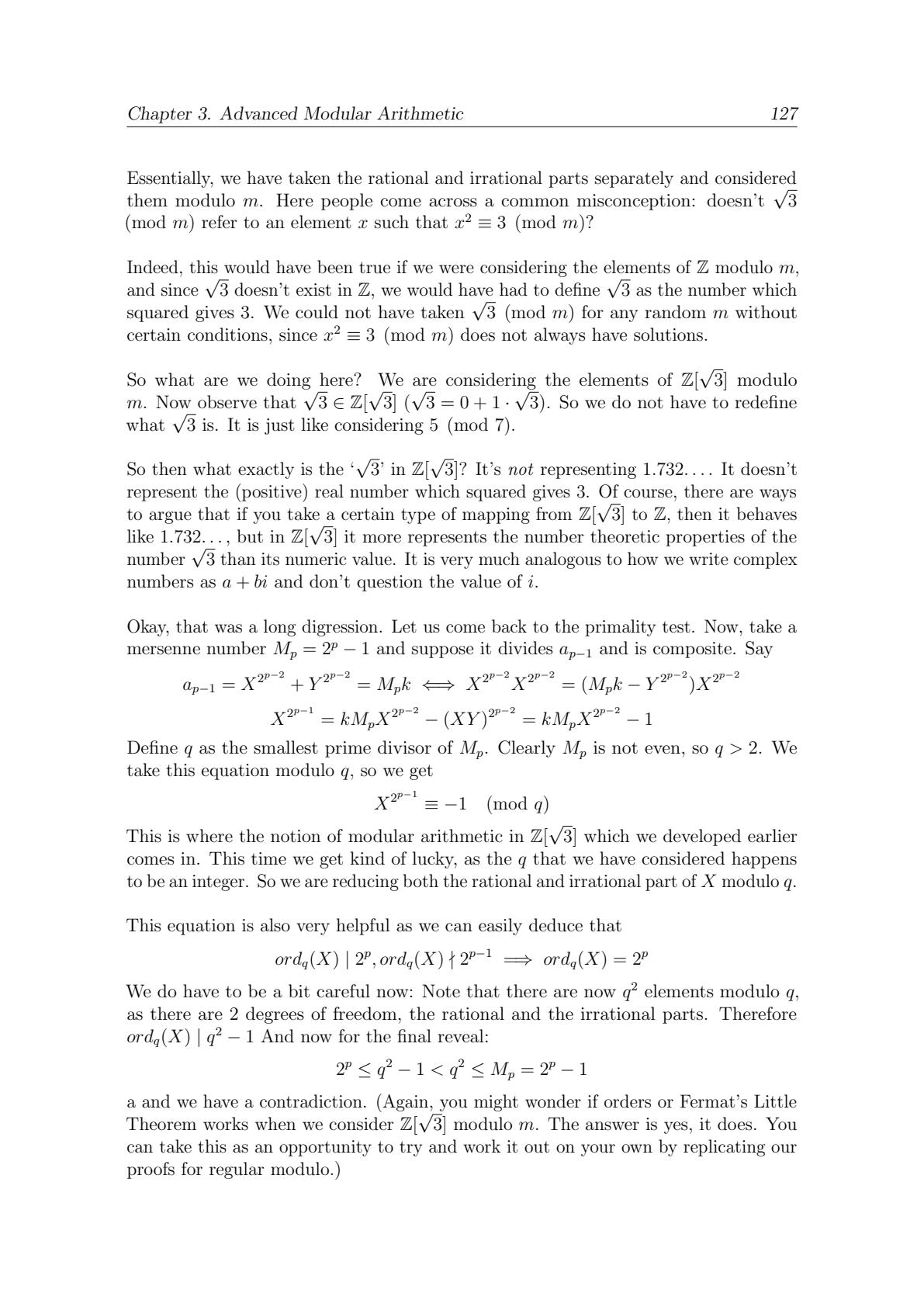
We are also attaching the chapter 3.1 (Orders) as a preview of the book.
Prerequisites for Readers.
Because this book is designed mainly for national level Olympiads like INMO and international Olympiads like the IMO, the reader should be comfortable with basic number theory, basic algebra, and common manipulations.
Chapter 1
The reader should be somewhat comfortable with the properties of modular arithmetic (addition and multiplication modulo an integer, statements of Fermat's Little Theorem, and Euler's Totient Function). Simply having read or knowing the definitions may not be enough; some experience working with modular arithmetic is recommended.
Chapter 2
The first bonus lemma uses the Maclaurin expansion of logarithms. However, this is used nowhere else, so there is no need to read up on it.
The Binomial Theorem is featured in one of the exercises. For the purposes of this chapter, not much familiarity is needed; knowing the statement is enough. Knowing the formulas for binomial coefficients is also required.
Being able to solve linear recurrences and knowing about the characteristic equation is recommended, though the use of this is not very extensive.
The bonus lemma for this chapter (the n=3 case of Fermat's Last Theorem) requires heavy use of algebraic number theory. However, the reader need not read up much, as it appears in very few places.
Chapter 3
For the Quadratic Reciprocity section, the reader must be comfortable with summations (properties like switching summations, etc.) and well-versed in the Binomial Theorem.
Chapter 4
For the Integer Polynomials section, the reader must be familiar with the algebraic properties of polynomials. Some of these are listed in the book, but it is helpful to have studied polynomials in some detail previously.
A little bit of differentiation is used here and there, but nothing too heavy. Knowledge of common derivatives, the product rule, and the chain rule is sufficient.
In one of the solved examples, we make use of integrals. Again, knowing the integrals of common functions is enough.
For the section on Cyclotomic Polynomials, having basic familiarity with complex numbers is enough. The section on the properties of Cyclotomic Polynomials does not have any extra prerequisites, but one must be comfortable with each property before moving on to the next.
Chapter 5
The reader must thoroughly complete the first section before moving on to the second section. There is no prerequisite for the first section. The second section requires a good knowledge of all the other chapters covered so far.
Chapter 6
For Size and Density in Number Theory, the content is slightly more algebraic. The reader must be able to work well with summations, especially in the density part.
For the section on Combinatorial Number Theory, the reader must be comfortable with ideas in combinatorics, such as graph theory, the Pigeonhole Principle, and a few local and global ideas. The OTIS Excerpts is a great resource for reading up on these topics.
Acknowledgements.
Firstly, both of us would like to thank our parents for supporting us throughout this journey. We would also like to express our sincere gratitude to Rushil Mathur, Malay Mahajan, Kanav Talwar, and Arindam Bhattacharya for their valuable advice, insightful suggestions, and continuous encouragement during the entire process.
We are deeply thankful to our friend Mandar Kasulkar for writing certain parts of the book. We would also like to thank our friends Ronit Sharma, Bairav Murugan, Paras Kumar, Tanishka Gham, Lavish Khariwal, and Nishant Sahoo for their generous assistance in reviewing the manuscript, proofchecking, identifying mathematical and grammatical errors, and offering numerous helpful comments. Special thanks to Roumak Das for helping us with the creation of this website.
Last, but certainly not least, we would like to thank Abhay Mahajan Sir, who has mentored both of us throughout our Olympiad journey and has also played the crucial role of helping us get in touch with publishers.